

The exquisite Pink Cockatoo (Lophochroa leadbeateri) is widely regarded as one of Australia's most spectacularly beautiful avian species. Endemic to the arid and semi-arid inland regions of the continent, its broad distribution spans the dry woodlands and timbered grasslands of Queensland, New South Wales, Victoria, South Australia, and Western Australia. These birds hold a unique position in the landscape, celebrated for their vibrant colours and animated presence.
Ecologically, the Pink Cockatoo is an important asset to fragile dryland ecosystems. As specialised foragers, they manage seed regulation across native plant species, including wattles and cypress pines. Furthermore, their reliance on intact, mature forests makes them a critical indicator species; their health directly mirrors the availability of hollow-bearing trees and the overall ecological integrity of Australia's vast interior.
Size and appearance
The Pink Cockatoo is a medium-sized parrot, measuring 35 to 40 centimetres in length with a weight ranging between 340 and 450 grams. While both sexes share a similar palette, subtle sexual dimorphism exists in their eye colour: mature males possess dark brown to black irises, whereas females feature lighter, reddish-brown eyes.
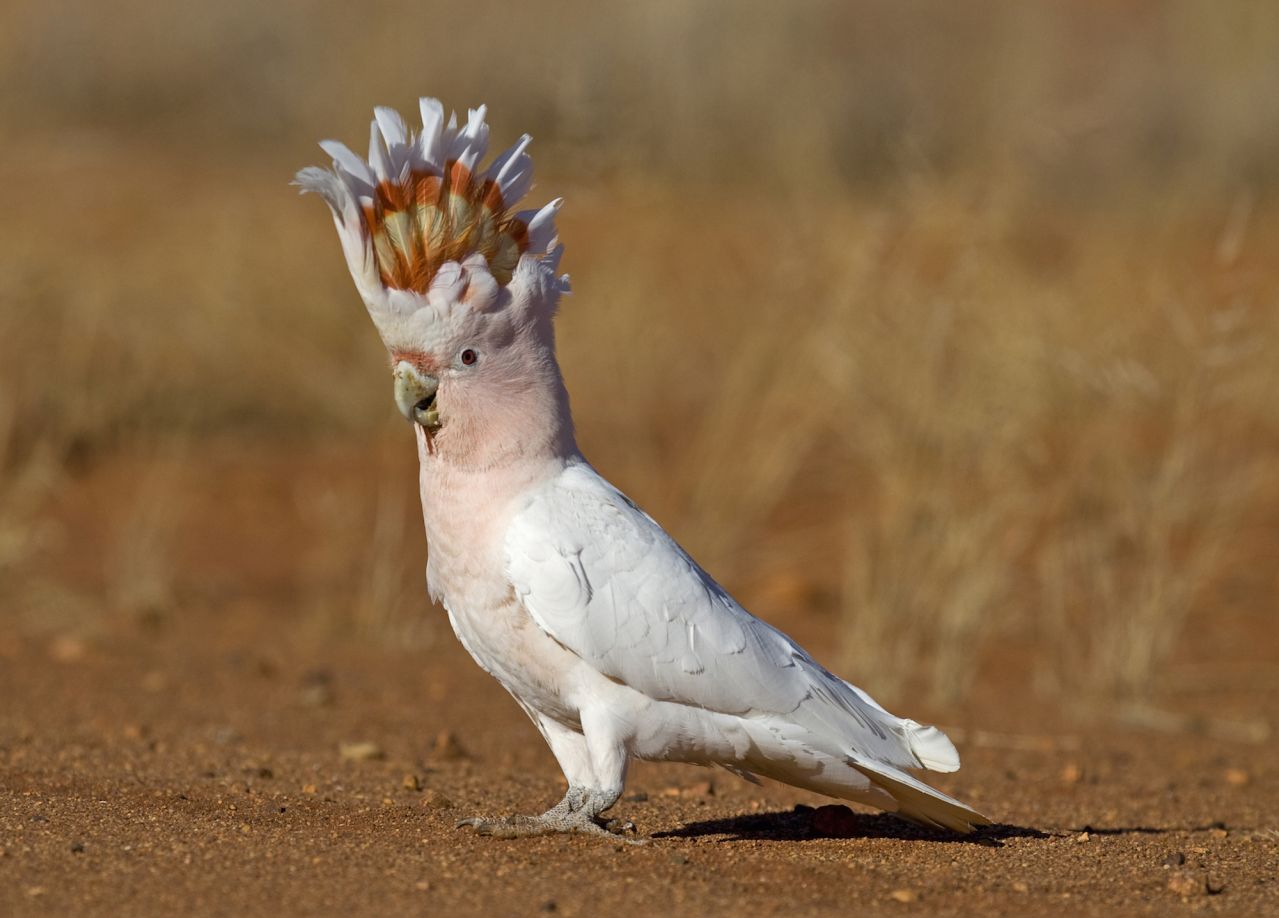
They are the only Australian cockatoos with a brilliant salmon-pink wash across the head, breast, and underbody, contrasting with clean white feathers on their back and wings. Their most breathtaking feature is a large, forward-curving crest. When raised, it reveals a broad scarlet-red band bisected by a vibrant yellow stripe. They also possess specialised zygodactyl feet, where two toes point forward and two toes point backward, providing an exceptional grip for climbing branches and manipulating food items.
Behaviour & Diet
Strictly diurnal, Pink Cockatoos adapt their routine to the climate. In summer, they forage for a few hours in the morning and late afternoon, resting in shaded canopies during the midday heat. They are highly territorial when breeding, defending an extensive home range of roughly 30 square kilometres and rejecting nearby nesting pairs. Outside of breeding season, they are nomadic, wandering in small family groups to track food and water.
Their diet is herbivorous, consisting of seeds from over 30 plant species, with a strong preference for native wattles (Acacia) and Slender Cypress Pine (Callitris). They also use their powerful bills to extract fruits, nuts, roots, tubers, and occasional insect larvae from decaying wood.
Breeding & Life Cycle
Pink Cockatoos form strong monogamous bonds and mate for life, returning to the same nesting sites annually. Breeding occurs from August to November, relying entirely on large natural hollows in ancient eucalypts or cypress pines aged between 80 and 140 years. Both partners prepare the nest together, lining the hollow floor with chewed woodchips and bark.
The female lays a clutch of 2 to 4 eggs, incubated sharedly for 23 to 26 days. Chicks fledge at around 8 weeks of age but remain dependent on their parents for several weeks to master essential foraging skills. In the wild, these long-lived birds boast an impressive life expectancy of 40 to 60 years.
Conservation & Threats
The Pink Cockatoo has faced severe population declines in recent decades. Consequently, the eastern subspecies (Lophochroa leadbeateri leadbeateri) is officially listed as Endangered under Australia's federal EPBC Act.
The primary driver of their decline is the ongoing loss and fragmentation of mature woodlands. Because they require century-old trees for nesting hollows, land clearing leaves many pairs unable to breed. Intense bushfires have also destroyed active nesting habitats, while overgrazing by livestock prevents the regeneration of key food plants. Furthermore, they face nest competition from galahs and threats from illegal poaching. Current conservation initiatives focus on protecting remnant woodlands and installing innovative simulated nesting cavities in fire-affected national parks.
Where to see Pink Cockatoos in the wild
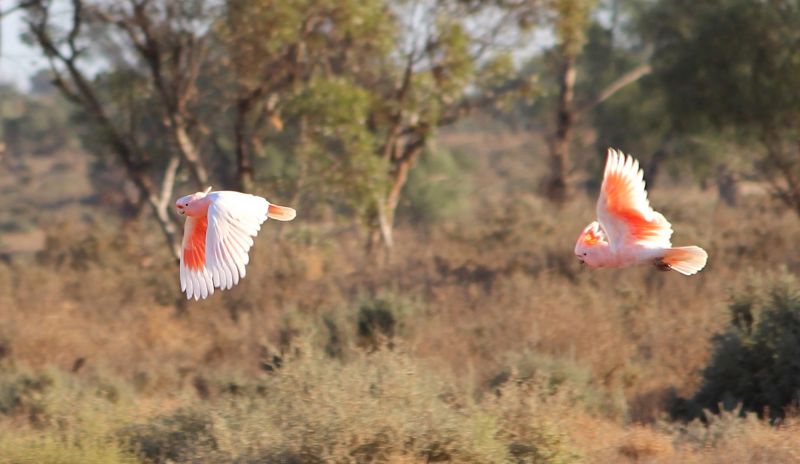
To experience the brilliant flash of a Pink Cockatoo in the wild, travellers must venture into the pristine semi-arid rangelands of the interior. While they occur in fragmented populations across inland Australia, one of the most reliable and breathtaking locations to observe them ethically is Mungo National Park in western New South Wales. Part of the Willandra Lakes World Heritage Area, this landscape features ancient stands of native cypress pine, mallee, and belah woodlands that provide ideal foraging grounds.
Visitors to Mungo National Park can watch these magnificent birds gliding over the iconic sand dunes and lunettes, or congregating around isolated watering holes at dawn and dusk. Observing them quietly from a distance as they interact in pairs provides a profound encounter with one of the outback's most spectacular endangered treasures.
Join Echidna Walkabout Nature Tours' 4 day Private Mungo Outback Journey for your best sighting opportunity.
FAQs
How can you tell them apart from galahs?
While both birds feature pink plumage, the Pink Cockatoo has a predominantly white upper body, wings, and back, whereas a Galah features a distinct slate-grey back and wings. Additionally, the Pink Cockatoo possesses a large, dramatic crest banded with scarlet and yellow, which a Galah lacks.
Why is the Pink Cockatoo's nesting requirement so specific?
Pink Cockatoos rely exclusively on large tree hollows found in eucalypts or cypress pines that are between 80 and 140 years old. Because they have extensive home territories and will not nest within close proximity to another breeding pair, vast areas of intact, old-growth woodland are absolutely vital for their reproductive success.
Are Pink Cockatoos migratory birds?
They are not strictly migratory, but rather nomadic. While breeding pairs remain highly resident and fiercely territorial during the spring months, they will wander extensively across hundreds of kilometres during the rest of the year to track down abundant seasonal food and water sources.