

The striking White-bellied Sea-Eagle (Haliaeetus leucogaster) is one of Australia's most magnificent raptors. Distributed widely across mainland coastlines, offshore islands, and major inland waterways like the Murray-Darling river system, this majestic bird of prey shares a deep, symbolic connection with coastal communities. Celebrated as a powerful guardian of the waterways, it plays a vital ecological role as an apex predator. By regulating aquatic and terrestrial prey populations and consuming carrion, these eagles help maintain the delicate balance of coastal ecosystems, serving as key indicators of overall environmental health.
Size & Appearance
Commanding the skies with a massive wingspan of 1.8 to 2.2 metres, the White-bellied Sea-Eagle is Australia's second-largest raptor, trailing only the wedge-tailed eagle. The species exhibits sexual dimorphism, with females being notably larger and heavier than their mates. Females typically weigh between 2.8 and 4.2 kilograms with a body length of up to 85 centimetres, while males weigh between 2.5 and 3.7 kilograms.
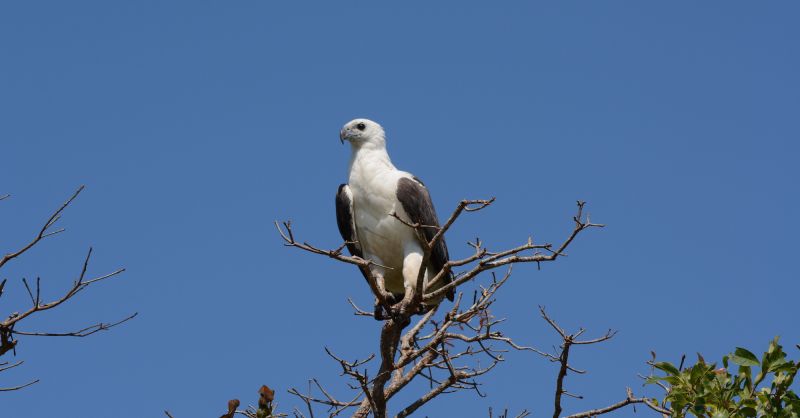
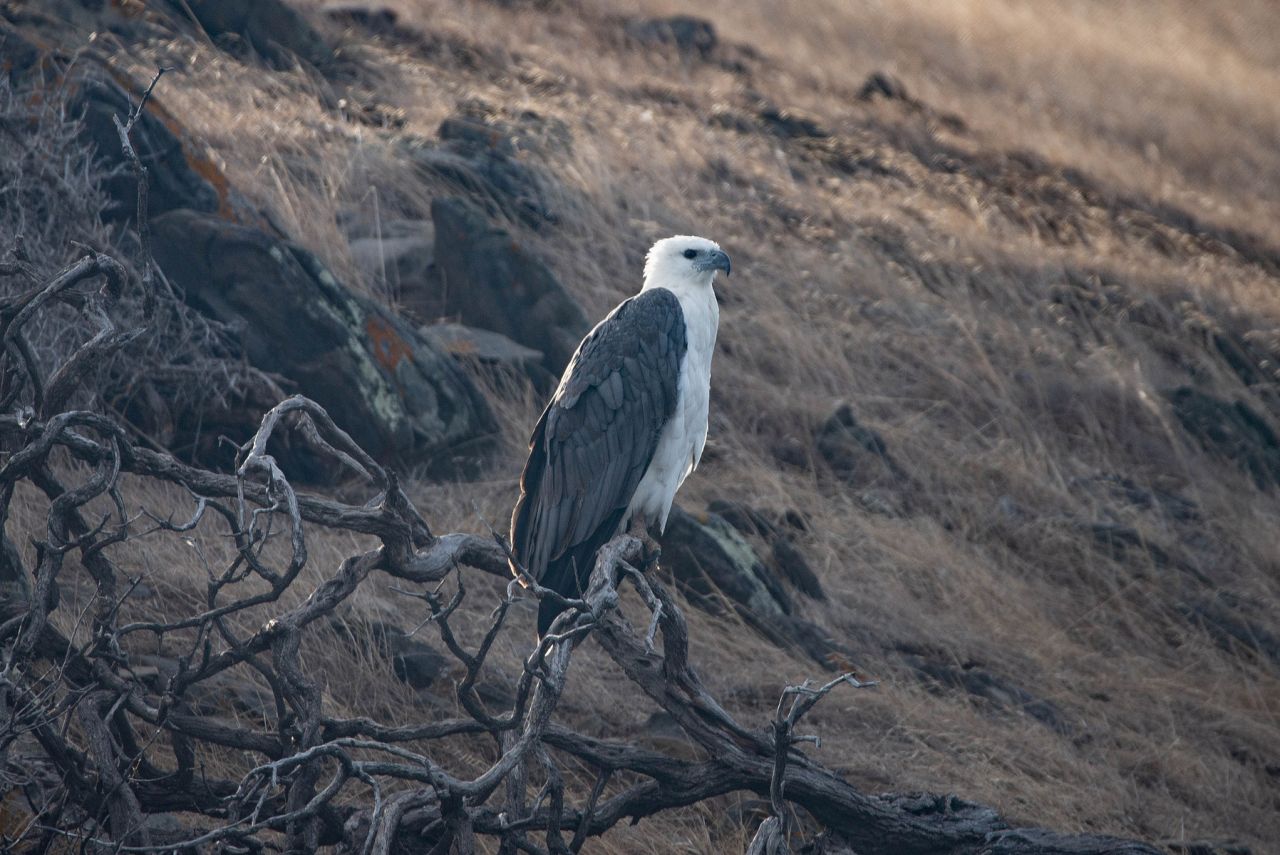
Adults feature a crisp white head, breast, and belly that contrasts sharply with a dark slate-grey back and upper wings. In flight, their underwing reveals black flight feathers paired with white coverts, trailing a short, wedge-shaped tail. Juveniles are completely different, sporting a mottled brown plumage that takes up to five years to gradually transition into adult colours. To excel at aquatic hunting, their lower legs are unfeathered to prevent waterlogging, and the soles of their powerful yellow feet possess rough scales (spicules) to tightly grip slippery fish.
Behaviour & Diet
Strictly diurnal, the White-bellied Sea-Eagle relies on its extraordinary eyesight to hunt from high perches or while soaring effortlessly on thermal air currents with wings upswept in a distinctive 'V' shape. They are highly territorial and typically live in permanent, lifelong pairs that defend extensive home ranges.
As opportunistic carnivores, their diet consists primarily of fish, sea snakes, freshwater turtles, waterbirds, and small mammals. They swoop down at a shallow angle to snatch prey cleanly from the water's surface using their powerful curved talons. These eagles are also notorious for kleptoparasitism, which means they frequently harass other coastal birds, such as ospreys or pelicans, in mid-air until they drop their catch, which the eagle deftly intercepts.
Breeding & Life Cycle
Breeding occurs from May to October in northern Australia, shifting to June to December in southern latitudes. Courtship features spectacular aerial displays where pairs loop-the-loop, drop objects from heights, and duet loudly. Together, they construct a monumental nest of sticks lined with green leaves, grass, and seaweed. Built high in tall eucalypts or on remote coastal cliffs, these nests are reused annually, growing up to four metres deep as new material is added.
The female lays two eggs, incubated for 40 to 42 days primarily by her while the male assists and hunts. Due to asynchronous hatching, the older, stronger chick often outcompetes the younger sibling. Nestlings fledge after 65 to 85 days and remain dependent on parents for another two to three months to master vital hunting skills. In the wild, they enjoy a long life expectancy of up to 30 years.
Conservation & Threats
Globally, the White-bellied Sea-Eagle is listed as Least Concern on the IUCN Red List and is not federally threatened under Australia's EPBC Act. However, regional populations face serious pressure; the species is listed as Endangered in South Australia and Vulnerable in New South Wales and Victoria.
The primary threat is habitat loss from coastal development and the clearing of old-growth nesting trees. They are exceptionally sensitive to human disturbance; close approach by vehicles or walkers during the early breeding season can cause pairs to permanently abandon their nests. Other threats include secondary poisoning, power line collisions, and wetland degradation. Conservation strategies focus on protecting nesting refuges and establishing "Fly Neighbourly" guidelines around active territories.
Where to see White-bellied Sea-Eagles in the wild
To observe these raptors ethically, look to the pristine coastal fringes, forested estuaries, and rugged offshore islands of southern and eastern Australia. They are regularly seen gliding over the sea cliffs of Tasmania, the Gippsland Lakes in Victoria, and the undisturbed coastlines of Kangaroo Island and the Eyre Peninsula in South Australia. Keeping a respectful distance during the breeding season ensures these majestic birds can successfully raise their young without disruption.
Some of the best places to see them include:
Freycinet Peninsula, Tasmania
Suggested Tasmanian tours:
- Tasmanian Wildlife Encounter (5 Days) - Premier Travel Tasmania
- Private Tasmanian Wildlife Encounter (4 Days) - Premier Travel Tasmania
Maria Island, Tasmania
Suggested Maria Island tours:
- The Maria Island Walk (4 Days) - The Maria Island Walk
- Winter Escape Walk (3 Days) - The Maria Island Walk
East Gippsland, Victoria
Suggested East Gippsland tours:
- East Gippsland Wildlife Journey (4 Days) - Echidna Walkabout Nature Tours
Kangaroo Island, South Australia
Suggested Kangaroo Island tours:
- Kangaroo Island In Style (2 Days) - Exceptional Kangaroo Island
- Kangaroo Island Birding (3 Days) - Exceptional Kangaroo Island
Eyre Peninsula, South Australia
Suggested Eyre Peninsula tours:
- Southern Eyre Peninsula Birdwatching (3 Days) - Australian Coastal Safaris
- Eyre Peninsula Ocean & Wildlife Encounters (3 Days) - Australian Coastal Safaris
Perth, Western Australia
Suggested Perth tours:
- Dolphin, Sea Lion & Penguin Island Cruise (2 Hours) - Perth Wildlife Encounters
Margaret River, Western Australia
Suggested Margaret River tours:
- Augusta Whale Watching (2.5 Hours) - Naturaliste Charters
- Dunsborough Whale Watching (2.5 Hours) - Naturaliste Charters
Atherton Tablelands, Queensland
Suggested Atherton Tablelands tours:
- Tropical Wetlands Birdwatching (1 Day) - FNQ Nature Tours
Hervey Bay, Queensland
Suggested Hervey Bay tours:
- Ultimate Hervey Bay Whale Watching (3 Hours) - Pacific Whale Foundation Eco-Adventures Australia
- Seven Island Ultimate Wildlife Cruise (2.5 Hours) - Pacific Whale Foundation Eco-Adventures Australia
FAQs
What is the difference between a White-bellied Sea-Eagle and a Wedge-tailed Eagle?
The White-bellied Sea-Eagle features a distinctive white head and underbody contrasting with dark grey wings, whereas the Wedge-tailed Eagle is entirely dark brown or black. Additionally, sea-eagles have unfeathered lower legs adapted for aquatic diving and are primarily found near coastal or wetland habitats.
Are White-bellied Sea-Eagles dangerous to humans or pets?
No, they are not dangerous to humans and are naturally wary of people. While they are powerful predators, their diet focuses on fish, reptiles, and waterbirds; domestic pets are not at risk unless they are very small and left entirely unattended near active coastal hunting grounds.
How long do White-bellied Sea-Eagles live for?
In the wild, White-bellied Sea-Eagle are known to live for up to 30 years.